UNESCO World Heritage Sites in Saudi Arabia: All 8, From Hegra to Al-Faw
There are eight UNESCO World Heritage Sites in Saudi Arabia, according to UNESCO’s own list for the Kingdom, checked on 17 October 2026 (UNESCO World Heritage Centre). Seven are cultural sites and one is a natural site. Here they are in the order they were listed, with the details UNESCO gives for each.
1. Hegra (Al-Hijr), 2008
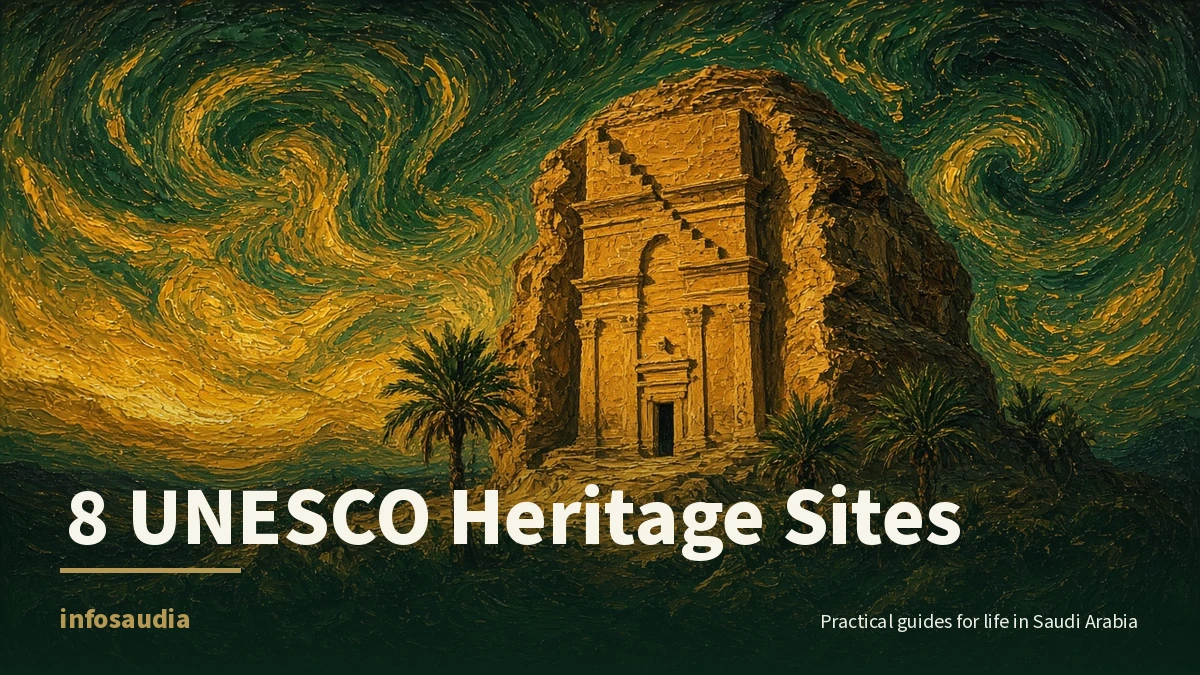
Hegra was the first site in Saudi Arabia to join the list. UNESCO calls it the largest conserved site of the Nabataean civilisation south of Petra. It has 111 monumental tombs, 94 of them decorated, dating from the 1st century BC to the 1st century AD, plus water wells and about 50 older inscriptions (UNESCO).
2. At-Turaif District in Diriyah, 2010
At-Turaif, north-west of Riyadh, was the first capital of the Saudi dynasty, according to UNESCO. It was founded in the 15th century and is a showcase of Najdi architecture: palaces and a whole old town built at the edge of the Diriyah oasis (UNESCO).
3. Historic Jeddah, the Gate to Makkah, 2014
UNESCO highlights Jeddah’s tall tower houses with large wooden roshan windows, built in the late 19th century, alongside coral-stone houses, mosques, souqs and small squares. For centuries the city was the gateway for pilgrims arriving by sea on their way to Makkah (UNESCO).
4. Rock Art in the Hail Region, 2015
This site has two parts: Jabal Umm Sinman at Jubbah, about 90 km north-west of Ha’il city, and Jabal Al-Manjor and Jabal Raat at Shuwaymis, about 250 km south of Ha’il. Their petroglyphs and inscriptions span almost 10,000 years of human history (UNESCO). Planning a trip? Read Visiting Ha’il: rock art, forts, and the roads that get you there.
5. Al-Ahsa Oasis, 2018
In the Eastern Province, Al-Ahsa is made up of twelve parts that together form the largest oasis in the world, with more than 2.5 million palm trees. The listing covers its gardens, canals, springs, wells, historic buildings and archaeological sites (UNESCO).
6. Hima Cultural Area, 2021
In south-west Saudi Arabia, on an ancient caravan route, Hima holds some of the oldest desert wells in the Middle East. UNESCO calls it a “library on rock”: petroglyphs spanning at least 7,000 years, and inscriptions in scripts including Musnad, Aramaic-Nabataean, South Arabian, Thamudic, Greek and Arabic (UNESCO).
7. ‘Uruq Bani Ma’arid, 2023
This is the Kingdom’s only natural World Heritage Site. It sits on the western edge of the Rub’ al-Khali (the Empty Quarter) and has one of the world’s largest systems of long sand dunes. It is also the last place Arabian oryx were seen in the wild, and it is now the focus of a successful programme to bring them back (UNESCO).
8. Al-Faw Archaeological Area, 2024
The newest site lies where the Empty Quarter meets the Tuwayq escarpment in the south. It shows human life from the Palaeolithic to the late pre-Islamic era: flint tools, stone funerary “avenues” from the 3rd millennium BCE, and burial mounds from about 2000 to 1900 BCE at the foot of Jabal Tuwayq (UNESCO).
Not on this list, but also UNESCO
UNESCO runs other programs too. In 2025 Ha’il’s Salma Geopark and North Riyadh Geopark joined UNESCO’s Global Geoparks Network (Arab News). Arabic coffee and other Saudi traditions are on UNESCO’s separate list of intangible cultural heritage.
FAQ
How many UNESCO World Heritage Sites does Saudi Arabia have?
Eight, as listed on UNESCO’s page for Saudi Arabia on 17 October 2026.
Which was the first?
Hegra (Al-Hijr), listed in 2008.
Which is the newest?
The Cultural Landscape of Al-Faw Archaeological Area, listed in 2024.
Is there a natural site?
Yes. ‘Uruq Bani Ma’arid, on the edge of the Empty Quarter, listed in 2023.